Edge AI vs Cloud APIs: Designing Hybrid Image Pipelines
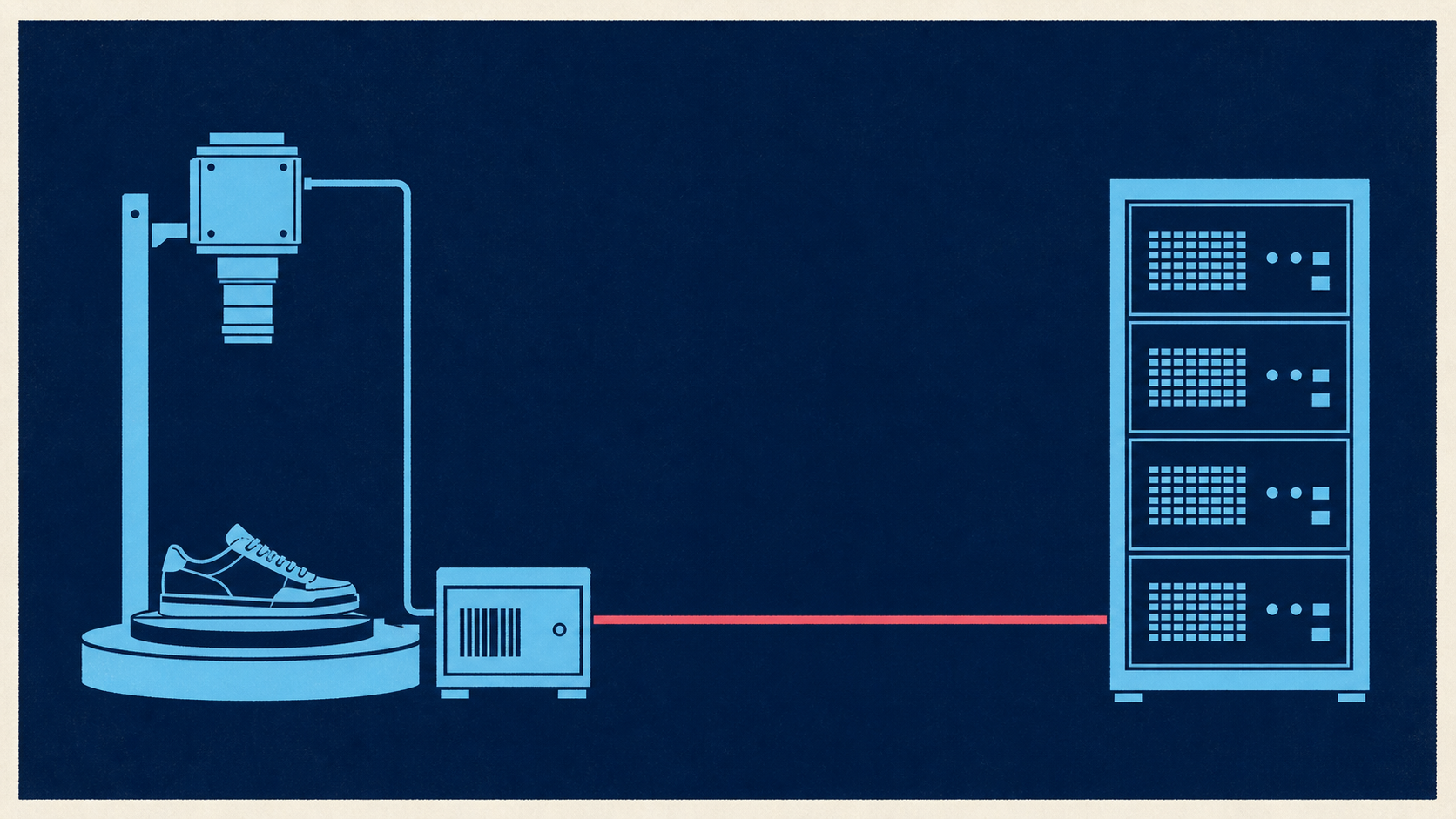
Image pipelines rarely belong entirely at the edge or entirely in the cloud. A camera station can reject an unreadable capture in milliseconds without uploading it, while a cloud API can run a larger enhancement or generation model that would not fit on a compact device. The useful architecture assigns each operation to the layer that can perform it reliably.
A hybrid pipeline is therefore not “edge first” or “cloud first.” It is a routing decision based on latency, connectivity, payload size, privacy, model requirements, and operational control.
What edge means in an image pipeline
The edge is the compute close to image capture or consumption. It may be a warehouse workstation, retail kiosk, industrial computer, mobile device, or regional service near the user. Edge processing can continue when the network is slow or unavailable and avoids a round trip for decisions that must be immediate.
Good edge tasks are bounded and predictable:
- checking file signatures, dimensions, orientation, and size limits;
- decoding a thumbnail and detecting a blank or corrupted capture;
- estimating blur, exposure, framing, or duplicate content with a compact model;
- removing unnecessary metadata before transmission;
- producing a smaller preview or upload derivative;
- queuing work locally during a network interruption.
These operations reduce wasted uploads and give the capture system a fast answer. They should not silently replace the approved master. Keep the original when the workflow requires later reprocessing, auditability, or a higher-quality cloud result.
What the cloud is better at
Cloud APIs are a better fit for models and workflows that need larger accelerators, frequent model updates, centralized policy, or elastic concurrency. Generative upscaling, background generation, context-aware restoration, and large multimodal models usually belong here.
The cloud also simplifies fleet management. Updating a model behind an API is easier than replacing a runtime on hundreds of store or warehouse devices. A centralized service can apply the same model version, quality policy, audit logging, and output validation across every location.
This does not mean every cloud call should receive the original camera file. An edge stage can select the right derivative, strip fields that are not needed, and reject files that violate the API contract. The guide to payload optimization and rate limits covers those controls in more detail.
Route by requirement, not by fashion
For each operation, record five properties:
- Response deadline. Does a person or machine need the answer before the next capture?
- Connectivity tolerance. Can the operation wait, or must it continue offline?
- Compute and memory. Can the target device run the required model at an acceptable quality?
- Data sensitivity. Can the source leave the device or region, and which derivative is permitted?
- Change frequency. How often will the model, threshold, or business policy change?
A compact blur check may score well for the edge. A high-resolution generative edit may score strongly for the cloud. Some operations can use both: an edge model supplies an immediate provisional result, while a cloud job produces the final commercial asset.
A reference hybrid flow
1. Capture and identify
Assign an immutable asset ID as soon as the camera writes the original. Record the device, capture time, product or job ID, and checksum in local durable storage. Do not use a filename as the only identity, because retries and parallel stations can produce collisions.
2. Validate locally
Decode a bounded preview and run deterministic checks before any expensive inference. Reject unsupported formats, dimensions outside policy, incomplete files, and captures that are clearly blank or out of focus. Keep thresholds versioned so operators can explain why a file was accepted or rejected.
3. Prepare the transfer
Create only the derivative required by the cloud operation. Preserve color management and orientation, and avoid repeated JPEG encoding. For large files, upload to controlled object storage and pass a short-lived reference to the processing service instead of moving the same bytes through multiple application servers.
4. Submit an idempotent job
Use the asset ID, operation, parameters, and input checksum to derive or store an idempotency key. A retry should retrieve the existing job rather than start another billable transformation. Apply a bounded timeout to submission, then treat accepted asynchronous work separately from the HTTP request that created it.
5. Receive the result asynchronously
Long-running image work should return a job identifier and complete through polling or a callback. Authenticate callback requests, deduplicate events, and fetch the result from a trusted location. The article on image API webhooks provides a complete callback pattern.
6. Validate and promote
Check output format, dimensions, file size, checksum, and policy before making the result visible. For product assets, compare geometry, labels, color, and included components with the approved source. Store the model or operation version with the result, then promote it atomically so downstream systems never read a partial file.
Offline behavior and backpressure
A hybrid design needs an explicit answer for network failure. The edge queue should be durable, bounded, and observable. When it approaches capacity, the station may pause capture, reduce optional variants, or keep only mandatory originals. Quietly accepting unlimited work creates a delayed outage when connectivity returns and every device uploads at once.
Reconnection should use jittered retries and a concurrency limit. Prioritize jobs by business value or deadline instead of replaying only by age. The same principles apply in a central worker fleet; see the guide to scaling high-volume image pipelines.
Security boundaries
Do not put unrestricted cloud credentials on an edge device. Use short-lived credentials with the minimum required scope, rotate them, and bind uploads to the expected object path or tenant. Treat remote input URLs as untrusted and protect fetchers against private-network access and oversized responses.
Keep customer or location metadata out of image payloads unless the processing operation needs it. Encrypt transport, record access decisions, and define retention for originals, previews, failed jobs, and outputs separately.
Observability across two layers
Use one correlation ID from capture through cloud completion. Measure local rejection reasons, queue depth, upload bytes, submission errors, cloud processing time, callback delay, and output validation failures. A single average latency hides whether time was spent waiting offline, uploading, queued in the cloud, or running inference.
A real-time optimization pipeline should also publish its current model and policy versions. Without that information, a quality change can look like random drift across locations.
The practical design rule
Keep immediate, bounded, privacy-sensitive checks near the image source. Send compute-heavy or rapidly changing transformations to a managed cloud service. Connect the two with durable identity, controlled transfers, idempotent jobs, asynchronous completion, and end-to-end observability.
The result is not a compromise architecture. It is a pipeline in which each layer performs the work it can operate most reliably.
