Self-Healing Image Pipelines: How Autonomous APIs Handle Processing Failures
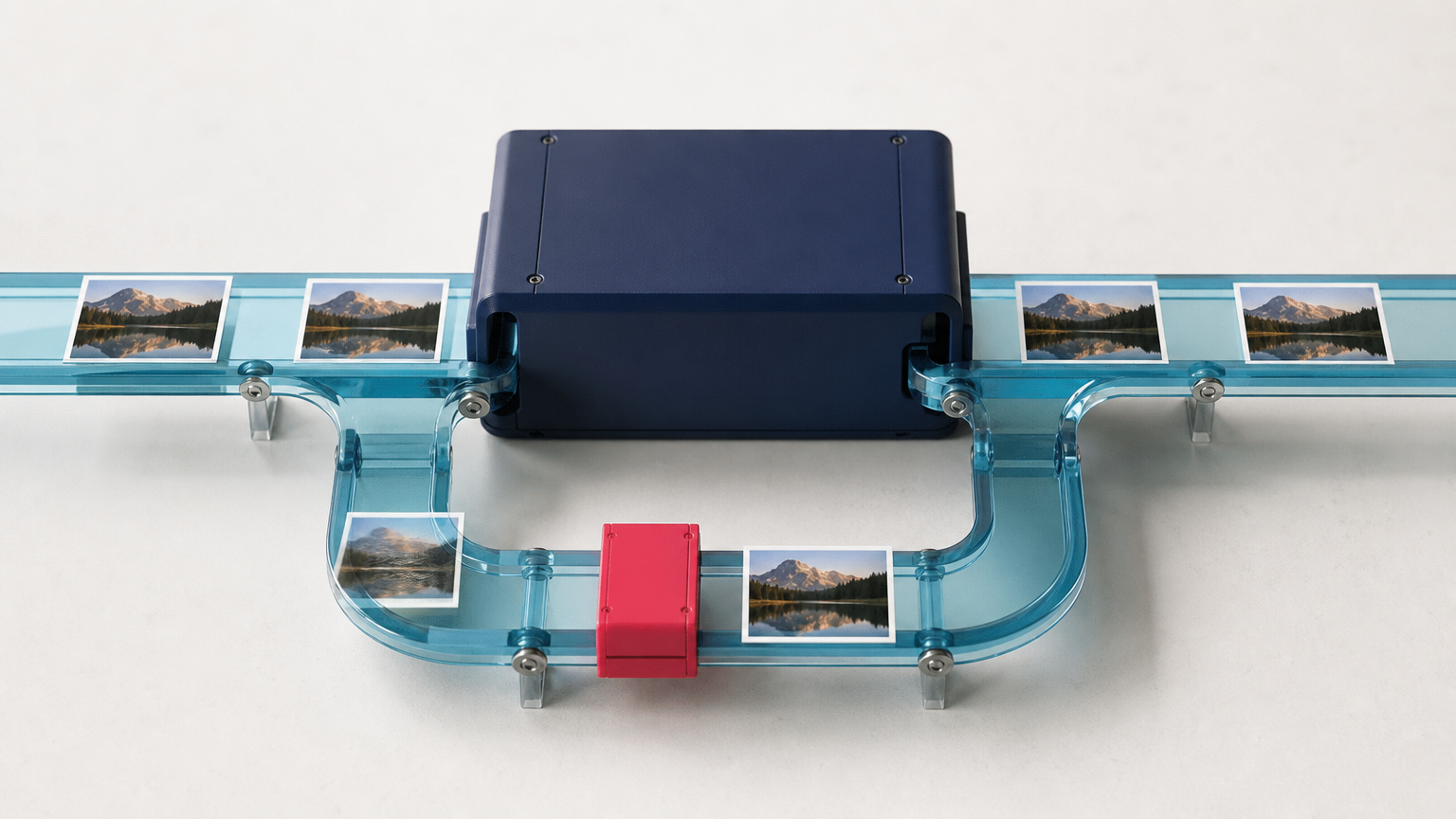
A batch image pipeline can look healthy right up to the moment a dependency slows down. A burst of uploads reaches an API rate limit. A worker loses its connection after submitting a job. A callback is delayed. A duplicate retry produces two candidate outputs for the same asset.
Autonomous image processing APIs are designed to make those events manageable without requiring an operator to inspect every failed request. The useful meaning of “self-healing” is not that a system can fix every problem by itself. It is that the workflow can detect a known failure class, apply a bounded recovery action, preserve a record of what happened, and route uncertainty to a human or an exception queue.
This article is for backend developers and data engineers building high-volume image workflows. It focuses on the architecture around image processing: intake, queues, retries, job state, webhook callbacks, validation, and escalation.
What makes an image pipeline self-healing?
A self-healing pipeline has explicit rules for recovering from expected, temporary failures. It does not treat every error as a reason to retry forever, and it does not treat every successful HTTP response as proof that a final image is ready to deliver.
In an image workflow, the system usually needs to answer five questions:
- Was the request accepted, rejected, or left in an unknown state?
- Is the failure temporary, permanent, or caused by missing input?
- Can the same operation be retried safely?
- How will the workflow learn that asynchronous processing has completed?
- When should the job stop and enter a review or dead-letter queue?
Those questions turn a vague promise of autonomy into an observable operating model. The recovery logic belongs in the surrounding orchestration layer, not in an assumption that an image API will make every downstream decision for you.
Start with a durable job record
Before calling an image-processing API, create a job record in your own system. Give it a stable internal operation ID and connect it to the immutable source asset version, requested transformation profile, destination, and correlation ID. This record becomes the reference point when a network timeout leaves the client unsure whether the provider received the request.
A practical job record should capture the current state, attempt count, timestamps, provider job reference once available, and a concise failure category. Keep the original source separate from any processed derivative. If a retry produces a new result, the workflow should be able to explain which output belongs to which attempt.
This is the foundation for idempotent image processing APIs. Idempotency means that repeating a request with the same operation identity does not silently create duplicate business effects. It is especially important when the caller times out after submission and cannot tell whether work has already started.
Classify failures before choosing a recovery action
A resilient image pipeline does not use one retry rule for everything. It classifies failures because a malformed source file and a temporary rate limit require different responses.
| Failure class | Typical response | What not to do |
|---|---|---|
| Temporary transport or service error | Retry with bounded exponential backoff and jitter. | Retry immediately in a tight loop. |
| Rate limit response | Slow submission, respect provider guidance where available, and release work gradually. | Send the entire batch again at once. |
| Invalid request or unsupported input | Stop automatic retries and record the validation reason. | Keep retrying unchanged input. |
| Unknown submission outcome | Reconcile using the stable operation ID or provider job reference before resubmitting. | Assume the request failed because the client timed out. |
| Completed job with an unusable output | Run output checks and route the job to review or a controlled retry path. | Deliver the output only because processing reached a completed state. |
Deep-Image.ai documents standard JSON error responses and a 429 response when an API rate limit is reached. Its documented asynchronous flow also supports processing jobs that return a job hash, then retrieving results by polling or webhook callback. Confirm the supported request details in the Deep-Image.ai API documentation before implementing a provider adapter.
Use queues to separate intake from processing
A queue creates a buffer between incoming assets and external processing capacity. Instead of allowing a large upload event to trigger thousands of direct API calls, the intake service validates the asset, records a job, and adds a small message to a queue. Workers pull work at a rate your system and provider can tolerate.
This separation makes recovery safer. If a provider is temporarily unavailable, the queue retains the work while workers pause or reduce concurrency. If a downstream destination is slow, completed jobs can wait in a delivery stage instead of blocking new intake.
Keep queue messages small and refer to immutable source records rather than placing image binaries in the message. Make the worker claim visible through a lease or state transition so that two workers do not process the same operation unintentionally.
Concurrency is a control, not a benchmark target
High concurrency can improve throughput until it causes rate-limit responses, overloaded workers, or delayed callbacks. Make concurrency configurable by queue and transformation profile. A simple controller can reduce active workers after a burst of temporary failures and increase capacity gradually only after a stable interval.
The goal is not maximum requests per second at all times. It is predictable progress across the complete batch.
Retry rate limits with backoff, jitter, and a budget
When many workers retry at exactly the same time, they can create a retry storm that extends the outage. Exponential backoff increases the delay after each failed attempt. Jitter adds a small random variation so jobs do not return to the API in lockstep.
Every retry policy also needs a budget. Define the maximum number of attempts, the maximum elapsed time, and the point at which a job becomes an exception. The budget should differ by workflow. A time-sensitive catalog preview may expire quickly. An archival batch may tolerate a longer pause if it protects the source and keeps the batch traceable.
Do not retry authentication, malformed input, or exhausted-account conditions as though they were temporary network errors. Those events need configuration, access, or capacity changes outside the worker.
For related capacity planning, see rate limits and payload optimization for image APIs. Reducing unnecessary payload size and smoothing submissions can make a retry policy more effective, but neither replaces clear failure classification.
Use webhooks as a completion signal, not a delivery decision
Asynchronous image processing often completes after the initial request has returned. Polling can work, but a webhook callback lets the provider notify your application when a result is ready. Deep-Image.ai documents webhook support for processing completion, which can reduce unnecessary status checks in a batch workflow.
A callback should move the internal job forward only after your system verifies that it matches a known operation and expected processing state. Store the provider job reference when a request is accepted, then use it to associate the callback with the correct source and transformation profile.
Webhook handling should be idempotent too. A callback can arrive more than once, arrive late, or be delivered after your system has already reconciled the job through another path. Processing the same completion event twice must not publish duplicate derivatives or send duplicate downstream notifications.
Our guide to reliable asynchronous image API webhooks covers the lifecycle concerns around callbacks, reconciliation, and downstream handoffs.
Validate the result before calling the job healed
A job that completed technically may still fail the workflow. The returned file might be missing, inaccessible to the intended destination, the wrong dimensions for a catalog, or disconnected from the source record your team expects. Self-healing needs an output-validation stage.
Validation can be simple and specific: confirm that the result exists, is associated with the correct operation, has the expected file type and dimensions for the named profile, and can be stored in the intended destination. For higher-risk transformations, add a separate visual or business-rule review state rather than pretending every automated output is ready for customers.
Do not create an invented quality score just to make the system look autonomous. Use checks you can explain, monitor, and revise.
Build an exception path for jobs that should not heal automatically
Some failures need intervention. A source URL may have expired. The asset may be corrupted. A destination permission may have changed. A provider result may conflict with the operation record. These belong in a dead-letter or exception queue with enough context for an operator to act.
Include the source identifier, operation ID, transformation profile, attempt history, latest error category, provider reference, and a safe link to the internal job record. Avoid exposing credentials or raw sensitive asset data in an alert. The purpose of the exception record is to reduce diagnosis time, not to turn a monitoring system into a new data store.
A good exception workflow has explicit outcomes: correct the input and resubmit as a new version, retry with a reviewed configuration change, cancel the operation, or approve manual delivery after review. This is where autonomy remains accountable.
A reference state model for batch image jobs
State names vary, but a small, explicit model prevents ambiguous handoffs. One example is:
- Received: The source and requested profile passed intake validation.
- Queued: The operation is waiting for worker capacity.
- Submitted: The provider accepted the request and a provider reference is recorded.
- Processing: The workflow is waiting for a webhook, poll result, or reconciliation check.
- Validating: A result was received and is being checked against the operation record.
- Delivered: The validated derivative reached the approved destination.
- Retrying: A recoverable failure is waiting within its retry budget.
- Exception: The job needs a decision outside automatic recovery.
The important rule is that transitions are recorded. A job should not jump from a timeout to delivered without evidence of how the system reconciled the unknown outcome.
Where Deep-Image.ai fits in an autonomous architecture
Deep-Image.ai can serve as the image-processing provider inside a broader orchestration layer. Your application owns the source record, operation identity, queue behavior, retry policy, validation rules, destination controls, and exception path. The provider adapter owns the documented API request and asynchronous result handling.
For an image workflow that includes background removal, start by testing representative source images in the Remove Background tool, then use the Remove Background API guidance to confirm the supported integration pattern. For other transformations, keep the same boundary: use approved profiles in your own system and map them to documented provider requests.
If you also need organization-wide controls over callers and destinations, pair recovery logic with the guardrails in policy as code for image APIs. A job should be allowed to retry only when it remains authorized to process the source and deliver the result.
FAQ
What is a self-healing image pipeline?
It is an image-processing workflow that can detect defined failure states, apply bounded recovery actions such as retries or reconciliation, record each decision, and route unresolved work to an exception path.
Should every failed image API request be retried?
No. Retry only failures that are likely to be temporary and safe to repeat. Invalid inputs, authorization failures, and exhausted capacity require a different action than a short network interruption.
Why does idempotency matter for image processing?
Network timeouts can leave a client unsure whether a job was accepted. Idempotency lets the workflow reconcile or repeat the same operation without creating duplicate business effects or confusing result ownership.
Are webhooks enough for reliable asynchronous processing?
No. Webhooks are a useful completion signal, but your system still needs event validation, idempotent handling, reconciliation for delayed events, output checks, and an exception path.
How should a batch image pipeline handle a rate limit?
Reduce submission pressure, retry with bounded backoff and jitter, and use a queue to retain work until capacity returns. Do not re-submit the entire batch immediately.
Build for recovery before the batch starts
The strongest autonomous image pipelines do not promise that failures disappear. They make known failures visible and routine. A durable job record, safe retries, queue-based backpressure, idempotent callbacks, output validation, and an exception queue turn a fragile batch script into an operating system for image work.
If you are designing an API-based image workflow, begin with one transformation profile and one realistic failure scenario. Test the recovery path using the Deep-Image.ai API documentation as the provider reference, then expand only when your records, retries, and review process make the next workload safe to operate.
